cinelog.org

cinelog.org header image 4

Remembering An Era’s Passing

March 29th, 2011 by ccrouch
Respond

On this week, back in 1997, Orange County bid farewell to it’s final formal drive-in, with the closure of Westminister’s Hi-Way 39.
.
 
Epitomizing drive-in culture, with near year round fair weather and an auto based social dynamic, the county was once home to twelve highly popular outdoor cinemas. Sadly, mirroring the genre’s decline elsewhere, all of Orange County’s ozoners eventually succumbed to the convenience of multiplexes and lucrative land deals; the “last stand” ending on March 31, 1997.
 
Below, is a listing of the long gone county drive-ins that helped to create countless memories of warm summer nights, family outings, and backseat adventure, for nearly fifty six years.   
 

Tags: No Comments.

Bi-Gone Personified

March 21st, 2011 by ccrouch
Respond

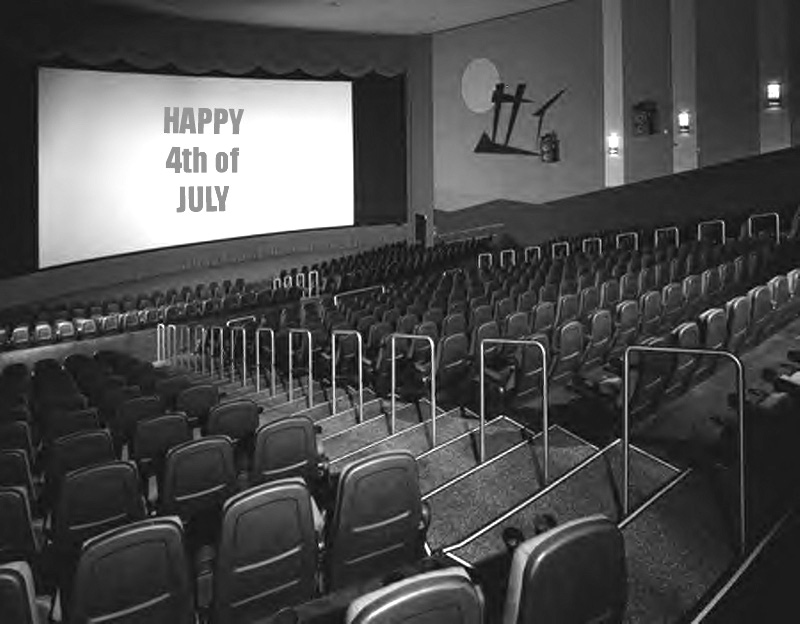
Today’s photo comes from the long out of print “Grauman’s Chinese Theatre Hollywood” feature journal the late Terry Helgesen produced with The Console back in 1969. I’m currently working on transferring the full journal in to a PDF file for your enjoyment, but I felt this particular photo, depicting the Chinese Theatre’s original seating fixtures, was worth hi lighting.
.
 
While today’s seats provide plush high backs, unobstructed views, and cup holder convenience, one can’t help but note what was lost in this modernization to creature comforts. The intricacy of design and attention to detail, on something as utilitarian as seating, speaking volumes about how much has changed in the movie going experience.    

Tags: No Comments.

Fade Out: The Pierside Pavilion 6

March 16th, 2011 by ccrouch
Respond

Huntington Beach’s Pierside Pavilion 6 is officially off the market. After sitting vacant, since 2008, the theatre was converted into 33,049 square feet of office and restaurant space this past December.  
 
Opened in May of 1991, the Pierside was operated by Mann (twice), Edwards, and The Movie Experience at varying times; none managing to make a successful go of it. Perhaps, a victim of too good a location, the theatre was never able to compete with the many draws of downtown Huntington Beach and the city’s famous coastline (literally, located across the street).
 
Seems like a likely candidate for a “forgotten cinema” post in the near future. But, for now, we can remember this pleasant little theatre through some pictures I took during a 2009 walk through.

Tags: No Comments.

Forgotten Cinema: The Fountain Valley Family 4

March 5th, 2011 by ccrouch
Respond

There are some theatres which fail to leave a notable mark on history due to a lack of long term financial success and/or poor location. Others quickly fade from the collective memory as a result of the sub par offerings they once provided. Then, there stands the unavoidable veil of time, which grows ever more thick with each passing year. In the case of the Fountain Valley Family Four Cinema, we find a theatre which may have disappeared from record and memory as the result of all these factors.
.
 
.
At best, I’ve been able to determine this location ran as a cinema from roughly 1974 through the early 90′s (possibly a bit earlier and longer). Originally a twin plex, the complex was expanded to four auditoriums sometime in the 1980′s. Located down the street from both the, comparatively luxurious, Fountain Valley Twin and, higher profile, Fountain Valley Drive-In, the Family Twin/Four looks to have operated as a lower end value cinema throughout much of it’s run. A one time Edwards venue, the theatre likely operated under a different banner during it’s early years, and later fell under the management of Orange Coast Cinemas.
 
This apparent final operator being the only significant point of formal record, as Orange Coast Cinemas was created as a starting point and educational endeavor for James Edwards’ daughter; the original goal being to prepare her for work in the family business (or so a lone newspaper article inferred). She would eventually move in to an executive position with Edwards Theatres, so the intention appears to have been a success, but the same couldn’t be said of the cinema itself.
 
After closing in the 90′s, the theatre sat vacant for a number of years, before being leveled and replaced by a Wal-Mart. Today, little evidence remains that this venue ever existed and the Fountain Valley Family Four remains one of Orange County’s forgotten cinemas.

Tags: 1 Comment

The Golden Era of Cinema Mascots

February 12th, 2011 by ccrouch
Respond

Corporate mascots have long been utilized as a marketing tool, to aid in creating a brand identity and accessible “face” for, otherwise, sterile business entities. While theatre operators have never managed to establish a mascot persona as recognizable as Ronald McDonald or the Geico Gecko, many have certainly attempted to place a colorful character at the helm of their corporate images; and, the 1990′s may have marked the theatre industry’s greatest push to initiate the use of mascots.
.

.

Prior to the early 90′s, theatre chains often placed, seemingly anonymous, characters in print advertising, policy trailers, and official literature. From humanized food items, to buffoonish cartoon patrons/staff, to non industry specific figures (ex: Pacific Drive-In’s weird grinning clown), the value of mascot imagery was recognized from the onset, but seldom executed in a purposeful fashion. Character identities were either undefined or not widely promoted; figures varied widely between media runs, never establishing a long term presence; or, in the case of those operators who licensed and/or “borrowed” well known imagery, lines of brand identity were blurred. However, this all began to change towards the end of the multiplex era.

The first defined and recognizable theatre mascot is surely up for debate (perhaps, the adult Pussycat Theatres’ “Pussycat Girl” of the 70′s?), but the ”golden era” or cinema mascots was kicked off in the late 80′s, when Cinemark established “Front Row Joe”. A cartoon feline, who bares an unmistakable likeness and personality to Frito-Lay’s Chester Cheetah, Joe began appearing in the chain’s pre show policy trailers around 1988. Usually featured in musical or comedy theme pieces, he was joined by an expanding cast of characters, which included a female interest, in “Popcorn Penny”, and villains “Elton” and “Clyde” (who were generally utilized to vilify poor movie going etiquette). When not greeting movie goers or wishing them a happy holiday season, Joe tended to focus on movie going life lessons.

Following close on the heels of Front Row Joe came General Cinema’s “Popcorn Bob” and AMC’s “Clip”. Bob, who’s presence was originally produced by George Lucas’ Lucasfilm, in 1993, was a broom handle nosed bag of popcorn; often joined in musical numbers by his “Candy Band” (which included “Pepsi Sue”). Clip, a creation of the Los Angeles based Metrolight Company, in 1994, an animated collection of film strips, which formed a stick figure like character, that surfed about and made squeaking noises. As with Cinemark’s Front Row Joe, Bob and Clip became mainstays of their respective chains’ policy trailers and literature. However, unlike Joe, they were also featured as facility decor. This was especially true of AMC’s Clip, who’s waving image was emblazoned across nearly any surface in need of decoration. Naturally, all three were personified via large foam rubber costumes, which were lent out for theatre openings and PR events (unfortunately, Clip’s costume replication resulted in a somewhat frightening and unnerving appearance).

Numerous other chains produced their own mascots during this period, with varying degrees of success, but the “big three”, of Joe, Bob, and Clip, remained the closest thing the industry ever had to the Michelin Tire Man. Each underwent significant upgrades in the new millennium, with Joe and Bob looking far more CGI as time passed. Clip proved to be the most constant of the bunch; while never achieving wide spread name recognition, “that film thing” has continued to be a cornerstone feature at AMC to the present day. Front Row Joe, while drifting out of use for a few years, reemerged recently; all be it in a less prevalent fashion. Sadly, Popcorn Bob completely disappeared from the scene after General Cinema Corporation was absorbed by AMC in 2002.

Today, aside from Clip, theatre operators appear to have abandoned their efforts to create memorable or identity defining corporate mascots. The highly customized policy trailers have been replaced by commercials and generic logos streaking across the screen. Friendly characters have given way to product placement and “alluring” concession combo deals. While lasting little more than a decade, the golden era of cinema mascots has passed.    

Tags: 1 Comment

The Variety Charity

February 4th, 2011 by ccrouch
Respond

If you have ever attended a movie in February, you’ve likely encountered Variety, the Children’s Charity. Prior to the mid 90′s, you may have seen a celebrity endorsed trailer for the charity, followed by a donation basket being passed through the audience. In more recent years, you’ve probably noted your theatre of choice selling gold, heart shaped, pins this time of year. For those who have ever wondered what this fundraising effort was all about, or why movie theatres were involved:

On Christmas Eve, 1928, an infant was discovered, abandoned, at the nursery of the Sheridan Square Theatre, in Pittsburgh, Pennsylvania. A note accompanying the child stated that the mother already had eight children and could not afford a ninth. The baby’s name was given as “Catherine” and the reason for choosing a theatre as, “I have always heard of the goodness of show business and I pray to God that you will look out for her.”

Fortunately, for Catherine, the theatre’s owner, John H. Harris, was one of eleven entertainment industry businessmen who had recently founded the Variety social club. He and his fellow Variety Club members decided that, since the infant had been entrusted to show business people, they should underwrite her financial care. Starting with that one abandoned child, who they named Catherine Variety Sheridan, the eleven businessmen began assisting other needy children; ultimately converting their local social club in to an industry wide charitable organization. In addition to long standing fund raising drives and telethons, the organization initiated the annual gold heart program in 1991; which has collected over $100 million for disabled and disadvantaged children to date.

As for Catherine; after becoming  somewhat of a period celebrity, she was adopted by a couple in Long Island, New York, and renamed Joan Riker (to afford her a more normal upbringing). She went on to become a nurse and start a family of her own, before returning to the spotlight in 1980, as an ambassador for the Variety Club charity. Ms. Riker passed away in 1994, but the organization founded around her continues to support children’s charities, hospitals, and camps throughout the United States and eight other countries.

As we enter February, movie theatres across the country will once again be selling gold heart pins to raise money for Variety, the Children’s Charity. If you happen to be catching a movie during this time, consider purchasing one of the $2 pins and help make a difference in the life of a child like Catherine. 

Tags: No Comments.

Orange County’s Forgotten Film Festival

January 25th, 2011 by ccrouch
Respond

Recent news of the Newport Beach Film Festival’s hurried search for a new venue brought to mind a lesser known county festival, which briefly attempted to carve out a cinematic niche,  just south of Newport.
 
Back in the late 90′s, the Laguna Beach Exchange Club (a local chapter of the now 100 year old service organization) was in search of a new fundraising vehicle for the group’s child abuse prevention charity. At the time, film festivals were somewhat of a hot social commodity, with nearly every artistic community of note attempting to create the next Sundance. As Laguna Beach already possessed a rich cultural history and was home to a number of renown art based programs, the club deemed an independent film festival the logical choice for both a fund raiser and community social event. So, in March of 1997, the Laguna Beach Film Festival was launched.
.
 
Utilizing the city’s Festival of Arts grounds, as local theatres were already tied in to an earlier incarnation of the Newport Festival (unrelated to the current event), the Laguna Beach Film Festival featured three days of independent films, workshops, and social mixers. While garnering modest attention and relying on video projection (as opposed to actual film), the event was successful enough to warrant two more years of activity.
.
   
 
Had organizers remained content in the event being a small, local, affair, the Laguna Beach festival likely would have continued on indefinitely. However, in what has almost become an aspiring film festival cliche, dreams of going “big time” soon derailed the event. Outside parties were brought in, a professional director was hired, and aspirations quickly moved beyond the event’s modest means. Far worse, the Exchange Club basically lost control and rights to their festival in the process.
 
While the film festival had struggled with the limitations of amateur, volunteer based, operations, the ”professionalization” of the planned fourth year proved to be a complete disaster. Bogged down under infighting, greed, and visions of self grandeur, the ”bigger and better” festival never managed to move beyond the early planning stages. Having failed to even put on another event, most of the parties involved moved on and the Laguna Beach Film Festival faded in to the realm of what “might have been”. 

Tags: No Comments.

A Setback for the Newport Beach Film Festival

January 17th, 2011 by ccrouch
Respond

With the closure of Edwards Island 7, organizers of the Newport Beach Film Festival find themselves scrambling to procure another theatre to replace the Fashion Island site. While the annual festival’s high profile Lido and Big Newport venues remain in place, there remains a need for a theatre that can play a more utilitarian role, accommodating the bulk of the 300+ films that have come to populate the ever expanding event.
.
 
Front runners mentioned thus far have included Edwards University 6 and Westpark 8; either one being seemingly ideal, from a facility standpoint, but their inland Irvine location adding an element of disconnection from the costal Newport based festival. A second option has been suggested by the Irvine Company (the party behind the Island 7′s closure/remodel), offering up space at the Fashion Island shopping center and a company sponsored work crew. However, the Fashion Island proposal appears to be more of an Irvine Company public relations move, than truly viable option. Whatever the end result might be, 2011′s Newport Beach Film Festival is looking to be a bit of a setback in the event’s, thus far, successful eleven year run.

Tags: 1 Comment

Edwards Island 7 Closes For Remodel

January 13th, 2011 by ccrouch
Respond

I stopped by Newport Beach’s Edwards Island 7 for the venue’s closing day (1/12/11). Per media accounts, the theatre will begin an extensive year long remodel and expansion tommorrow. While earmarked for a December 2011 reopening, there has yet to be an announcement on who the future operator will be. If the lack of advertising and downbeat mood of staff/management is any indication, it certainly won’t be Edwards/REG.  
.
       
.
For more pictures of the theatre, please click on the “Newport Beach’s Edwards Island 7″ link above.

Tags: 1 Comment

The Familiar Scourge For Laguna’s South Coast Cinemas

January 5th, 2011 by ccrouch
Respond

Over the holidays, Laguna Beach’s South Coast Cinemas faced off with an all too familiar threat, as heavy rain storms sent a river of mud and water through the downtown area. Flooding proved so severe that most of downtown Laguna was closed off for two days, with many area merchants experiencing significant property damage and a full week of cleanup in the aftermath. While the theatre was forced to pump out several inches of water and removed a carpet of mud from the forecourt area, the cinema escaped relatively unharmed; reopening in time for Christmas.
 
A semi annual occurrence, flooding has been a regular threat to the South Coast site since it’s inception. The property’s original theatre was damaged, beyond repair, during a flood in the early 1930′s; being rebuilt in to the brick and mortar structure we see today, in 1935.

Tags: No Comments.